Placing AGACNP students into Oregon's acute-care units
Oregon's acute-care capacity is concentrated along the Interstate 5 corridor, and it peaks in Portland, home to the state's only academic Level I trauma center. For an AGACNP student that means your ICU, step-down, emergency, and inpatient specialty hours are tied to a short list of larger systems, and getting inside them is the real task. That sourcing is what we do.
Tell us your school and city. It is free to ask, with no obligation.
The Oregon map begins in Portland
Portland carries the densest acute-care capacity in Oregon. It holds the state's only academic Level I trauma center at OHSU, a large teaching and referral hospital, along with a second adult Level I trauma center at Legacy Emanuel and the multi-hospital footprints of Legacy Health and Providence. Together these systems run the deep intensive care, cardiac, neuro, and trauma services that produce high-acuity hours.
South of Portland, the Interstate 5 corridor carries the next tier: the Salem area, the Eugene area, and the Medford area in the south, plus Bend on the other side of the Cascades in central Oregon. These regional centers host real ICU, step-down, emergency, and hospitalist work, which matters because not every student can or should commute into Portland for a full rotation.
Full practice authority and who precepts you
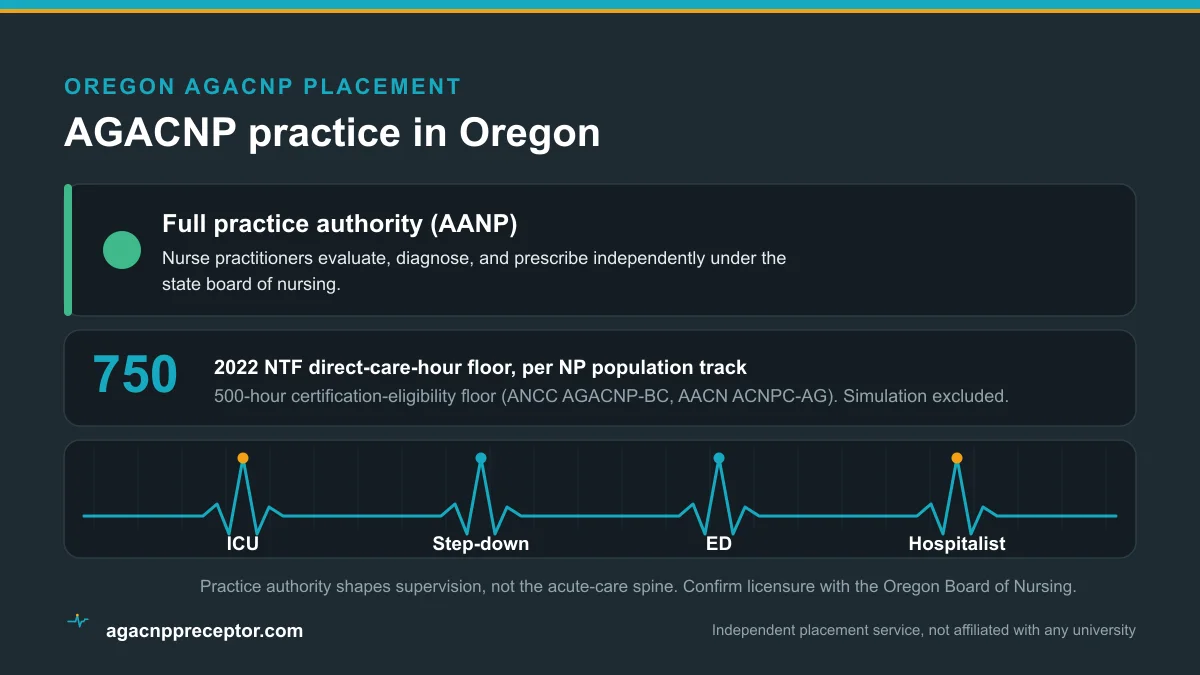
Oregon is a full-practice state in the AANP State Practice Environment, and has been for many years. Nurse practitioners in Oregon evaluate, diagnose, order and interpret tests, and manage treatment, including prescribing, under the authority of the Oregon State Board of Nursing, without a required collaborating-physician agreement.
In practice this widens who can serve as your preceptor. An experienced adult-gerontology acute-care nurse practitioner or an intensivist team can take a student with more independence than in a supervised state. Even so, critical care is team care, so you will still work alongside attending physicians on the unit. Full authority changes the paperwork and the independence of your preceptor, not the core clinical qualifications the role requires.
Which units carry your hours
An AGACNP rotation in Oregon is built from inpatient and high-acuity services, not outpatient clinics. Expect your time to come from a mix like this:
- Intensive care across medical, surgical, cardiac, and neuro units.
- Step-down or progressive care for patients too sick for the floor and past the ICU.
- Emergency departments, including the high-volume Portland trauma centers.
- Hospitalist and inpatient medicine services managing the adult census.
- Inpatient specialty teams in cardiology, pulmonology, nephrology, and surgical or trauma care.
The population spans young adults, older adults, and the frail elderly, the adult-gerontology acute-care core.
East of the Cascades: the rural reality
Most of Oregon by land area, the high desert east of the Cascades, the coast range, and the southern counties, is served by critical-access and small community hospitals. They handle emergencies and stabilization, then transfer the sickest patients west to Portland or to a regional center like Bend. For an AGACNP student that means the intensive care, procedural, and specialty hours are usually earned by traveling to a metro, even for residents of those regions.
We plan around that geography deliberately, pairing any hours you can log locally with a metro block that covers the high-acuity requirements, so the calendar works instead of falling apart late in the program.
The scarcest hours in Oregon
Because so much high-acuity capacity sits in a handful of Portland systems, the hardest hours to secure are competitive. High-acuity intensive care seats, procedures and advanced skills such as central lines and airway management, and the adolescent edge of the range near age 13 are the pieces students most often struggle to find on their own.
Telling us which of these you still need lets us target sites that can deliver them, rather than filling a calendar with hours you already have.
Placing you, start to finish
We are independent and work for students at any university, online or in person. Give us your program, your city, and the rotations you are missing, and we source a qualified acute-care preceptor and an approved inpatient site, then carry the vetting and hospital paperwork. We do not promise placement or your school's sign-off, since neither is ours to grant, but you are matched first and pay only when a placement is secured.
If an Oregon ICU or step-down requirement is stalling your progress, start on the match form and we will come back with a plan.
Good to know
Do I have to rotate in Portland to finish my AGACNP hours in Oregon?
Not entirely, but often partly. Regional centers around Salem, Eugene, Medford, and Bend host solid ICU, step-down, and hospitalist work. The deepest high-acuity, trauma, and subspecialty capacity, though, sits in Portland, so many students log at least some hours there.
Does Oregon's full practice authority make placement easier?
It can widen your preceptor pool, because an experienced acute-care nurse practitioner can take you on without a required physician agreement. It does not remove the real bottleneck, which is hospital access. Inpatient sites still gatekeep students through credentialing and affiliation agreements, and that is the part we work through.
I live east of the Cascades. What does my rotation look like?
Your local critical-access hospital can cover some general and emergency time, but the intensive care, procedural, and specialty hours usually mean traveling to Bend or to Portland. We build that into your plan up front so the travel is scheduled, not a surprise.
How many clinical hours does an AGACNP program require?
It varies by school. The 2022 NTF Standards recommend a minimum of 750 direct patient care hours, and certification eligibility requires at least 500 faculty-supervised hours, with many accredited programs publishing totals between those figures. Always confirm your own program's requirement; our hours guide explains the ranges.
Can you place me if I attend an online AGACNP program?
Yes. We serve students at any university, including online programs, and place them into Oregon acute-care sites. Your hours are earned where you live under Oregon's rules, so this state's landscape is what shapes your search.
Related
Secure the rotation no one else will hand you
Tell us your school, your city, and the acute rotations you still need. We will come back with a plan for the full AGACNP trace and a realistic path to placed.