Placing AGACNP students in Rhode Island's acute-care units
Rhode Island is a small, dense state with a single dominant hospital market in Providence, home to the region's only Level I trauma center. For an AGACNP student that concentration is both an advantage, because the high-acuity units are close together, and a constraint, because the seats in them are limited. Sorting that out is the work we take on.
Tell us your school and city. It is free to ask, with no obligation.
A one-metro acute-care state
Almost all of Rhode Island's high-acuity capacity sits in and around Providence. Rhode Island Hospital is the state's only Level I trauma center and its largest academic and referral hospital, running the deepest intensive care, cardiac, neuro, and surgical services in the state. Nearby, The Miriam Hospital adds cardiac and inpatient medicine within the same health system, while Care New England, anchored by Kent Hospital in Warwick, provides another block of inpatient and emergency capacity.
Because the state is so compact, distance is rarely the problem an AGACNP student faces here. The real issue is that a small number of hospitals hold most of the acute beds, which makes the high-acuity rotations competitive.
Full practice authority in a small market
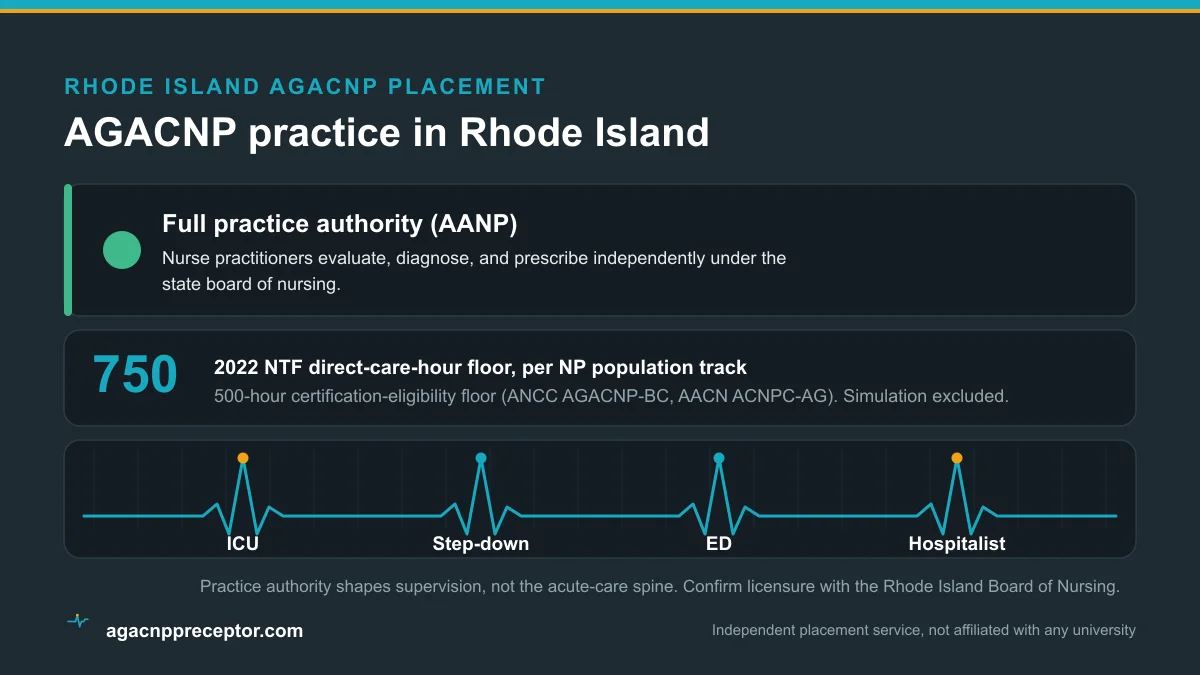
Rhode Island is a full-practice state in the AANP State Practice Environment. Nurse practitioners evaluate, diagnose, order and interpret tests, and manage treatment, including prescribing, under the authority of the Rhode Island Board of Nurse Registration and Nursing Education, without a mandated collaborating agreement.
For placement, full authority means an experienced adult-gerontology acute-care nurse practitioner can precept you directly, which widens the pool of possible preceptors. It does not change the fact that intensive care is delivered by a team that includes intensivists, so you will still learn alongside physicians on the unit. The category affects the supervision behind your preceptor, not the qualifications the role demands.
The units your hours come from
An AGACNP rotation in Rhode Island is inpatient and high-acuity by nature. Your hours are drawn from services like these:
- Intensive care, medical, surgical, cardiac, and neuro, concentrated in the Providence academic hospital.
- Step-down and progressive care for patients between the ICU and the floor.
- Emergency departments, including the state's only Level I trauma center.
- Hospitalist and inpatient medicine services managing the adult census.
- Inpatient specialty teams in cardiology, pulmonology, nephrology, and surgery.
The patients span young adults, older adults, and the frail elderly, the heart of the adult-gerontology acute-care population.
When a small market gets crowded
Rhode Island has few critical-access hospitals compared with a large western state, so travel distance is seldom the barrier. Instead, the constraint is volume: with most acute beds in a handful of Providence hospitals, students from several programs compete for the same intensive care and specialty rotations. Timing matters more here than geography, because the best sites fill early.
That is why we start a Rhode Island search well ahead of the term. Getting in front of the credentialing and scheduling queue is often the difference between a placed high-acuity rotation and a scramble.
The hardest hours to secure
The scarce pieces in Rhode Island mirror the national pattern, sharpened by the small market. High-acuity intensive care seats, procedures and advanced skills such as line placement and airway management, and the adolescent end of the range near age 13 are the hardest to line up on your own.
When you tell us which of these you still need, we can focus your search on the one or two sites that actually offer them rather than sending applications everywhere.
How we place you here
We are independent and serve students at any university, in state or online. Tell us your program, your city, and the rotations you are missing, and we source a qualified acute-care preceptor and an approved inpatient site, then carry the vetting and hospital credentialing. We never guarantee placement or your school's approval of a preceptor, but you are matched first and pay only when the placement is secured.
If a Rhode Island ICU or step-down requirement is in your way, start on the match form and we will map your options.
Good to know
Is all of Rhode Island's acute-care capacity in Providence?
Most of it. Rhode Island Hospital in Providence is the state's only Level I trauma center and its main academic hospital, and it holds the deepest intensive care. Warwick and other nearby communities add inpatient and emergency capacity, but the highest-acuity work centers on Providence.
Does full practice authority make finding a preceptor easier in Rhode Island?
It helps, because an experienced acute-care nurse practitioner can precept you without a required physician agreement, which widens the pool. The tighter constraint here is the small number of hospitals and the competition for their high-acuity seats, which is what we work to get you ahead of.
The state is small, so why is placement still hard?
Because acute capacity is concentrated. A handful of Providence hospitals hold most of the intensive care and specialty beds, and students from multiple programs want the same rotations. Distance is rarely the issue in Rhode Island; timing and access are, and that is where we focus.
How many AGACNP clinical hours will I need?
It depends on your program. The 2022 NTF Standards recommend at least 750 direct patient care hours per track, certification eligibility requires at least 500 faculty-supervised hours, and accredited programs commonly publish totals in that range, many under 750. Confirm your own number and see our clinical hours guide.
Can you help if I am in an online AGACNP program?
Yes. We place students at any university, including online programs, into Rhode Island acute-care sites. Your hours are earned where you live under Rhode Island's rules, so this state's compact landscape is what shapes your search.
Related
Secure the rotation no one else will hand you
Tell us your school, your city, and the acute rotations you still need. We will come back with a plan for the full AGACNP trace and a realistic path to placed.