Acute-care rotations for AGACNP students in South Carolina
South Carolina spreads its acute-care capacity across three hubs, Charleston in the Lowcountry, Columbia in the Midlands, and Greenville with Spartanburg in the Upstate. Your AGACNP hours, the ICU, step-down, emergency, and hospitalist time, come from getting inside those hospital systems, which is exactly the access we source. That work is the point of this service.
Tell us your school and city. It is free to ask, with no obligation.
South Carolina's three acute-care hubs
Unlike states built around a single dominant city, South Carolina runs on three regional anchors. In the Lowcountry, MUSC Health in Charleston is the academic medical center and the region's only Level I trauma center, with the state burn center and deep intensive care. In the Midlands, Prisma Health's Richland campus in Columbia is a Level I trauma center and a large academic hospital, including a dedicated surgical trauma intensive care unit. In the Upstate, Prisma Health's Greenville hospitals and Spartanburg Regional carry the high-acuity load for the northwest.
For an AGACNP student, which hub you sit near shapes your whole plan, because each anchor holds the intensive care, cardiac, and specialty services that the surrounding smaller hospitals transfer their sickest patients into.
The units that host AGACNP hours
Adult-gerontology acute care happens inside the hospital, so your South Carolina rotations are built from high-acuity and inpatient services:
- Intensive care in medical, surgical, cardiac, and neuro forms, deepest at the three academic anchors.
- Step-down and progressive care for patients moving out of the ICU.
- Emergency departments, from Level I trauma centers to busy community EDs.
- Hospitalist and inpatient medicine teams carrying the adult census.
- Inpatient specialty services in cardiology, pulmonology, nephrology, and trauma or surgery.
Your patients run from adults through older adults to the frail elderly, the population this track is designed for.
Restricted practice and the supervising physician
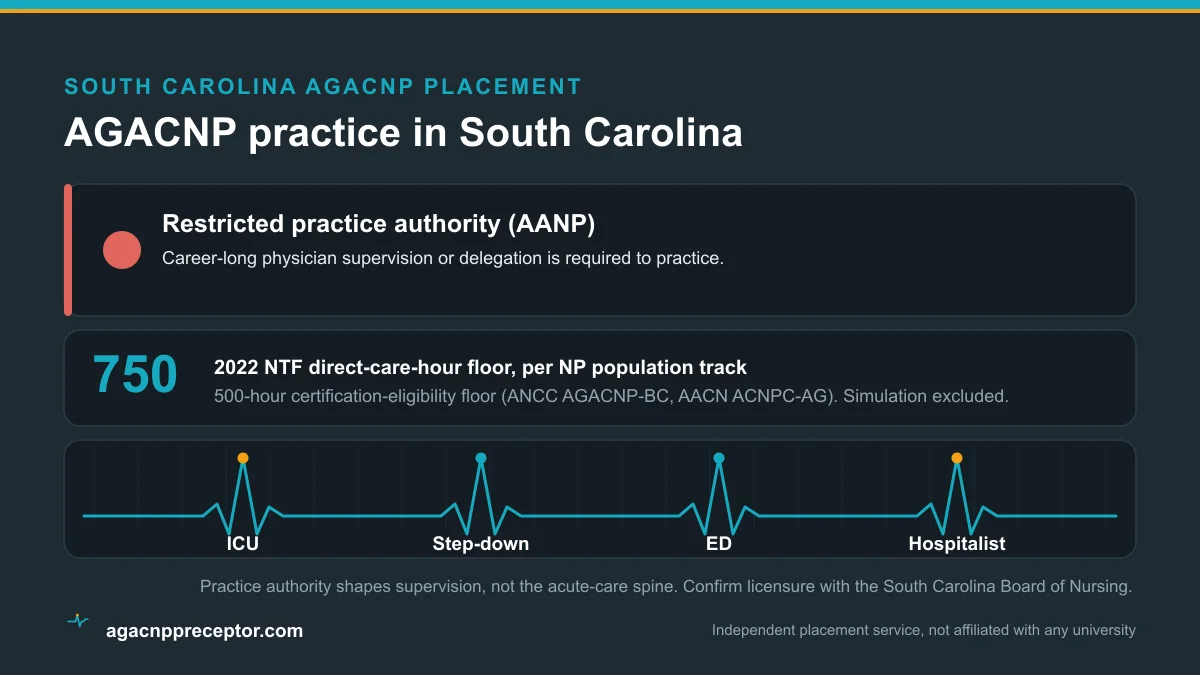
South Carolina is a restricted-practice state in the AANP State Practice Environment. Nurse practitioners work under a practice agreement with a supervising physician, which shapes the arrangement under which you are precepted. Confirm the current requirements, including any distance or chart-review rules, with the South Carolina Board of Nursing.
On an acute-care unit this matters less than it sounds. Intensive care and hospitalist services are already team based and physician led, so a supervising or collaborating physician is standard in high-acuity settings no matter the state category. The restricted-practice rule mostly influences who formally signs on as your preceptor and how the supervision is documented, not the clinical qualifications the preceptor holds.
The Pee Dee, the coast, and the rural gaps
Between the three hubs, much of South Carolina is rural. The Pee Dee region, the rural Lowcountry outside Charleston, and the smaller Upstate counties depend on community and critical-access hospitals that manage emergencies and general medicine but transfer complex cases to Charleston, Columbia, or Greenville. AGACNP students in those areas generally travel to a hub for intensive care and specialty hours.
We plan for that from the start, matching whatever hours you can earn locally with a hub block that covers the high-acuity requirements, so your calendar holds together through the program.
Which hours are hardest to secure
The scarce hours in South Carolina follow the national pattern. High-acuity intensive care seats sit in a small number of academic centers, procedures and advanced skills depend on a preceptor who will teach them at the bedside, and the adolescent end of the range near age 13 is thin outside larger hospitals that admit younger teens.
Once we know which of these you still need, we can aim your search at the hubs that can actually provide them instead of spreading you across sites that cannot.
How we place AGACNP students in South Carolina
We are an independent service for students at any university, not connected to any school. Give us your program, your city, and the rotations you are missing, and we source a qualified acute-care preceptor and an approved inpatient site, then handle the vetting and the affiliation and credentialing paperwork hospitals require. We do not guarantee placement or your school's approval of a site, but you are matched first and pay only when the placement is secured.
If a South Carolina ICU or hospitalist requirement is stalling you, start on the match form or reach us through contact, and we will map a path to placed.
Good to know
Which South Carolina cities have the strongest acute-care hours?
Charleston, Columbia, and Greenville. Each anchors a region with a Level I trauma center or major academic hospital and the multi-tier intensive care that comes with it. Students near Spartanburg also have strong Upstate options. Rural residents usually travel to one of these hubs for high-acuity time.
Does South Carolina's restricted-practice rule limit who can precept me?
It shapes the supervision arrangement more than your preceptor's qualifications. Your preceptor is still generally a board-certified acute-care nurse practitioner or a physician in a matching inpatient role. In an ICU, a supervising physician is standard regardless, so the restricted category rarely changes your rotation itself.
I live in the Pee Dee or a rural county. Will I have to travel?
For the highest-acuity hours, usually yes. Community and critical-access hospitals cover emergencies and general medicine, but the multi-tier ICU and specialty services are in Charleston, Columbia, and Greenville. We build that travel into your plan up front.
How many acute-care clinical hours will my program require?
It varies by program. The 2022 NTF Standards recommend at least 750 direct patient care hours per track, certification eligibility requires at least 500 faculty-supervised hours, and accredited AGACNP programs commonly publish totals in that range, many below 750. Confirm your own requirement and see our clinical hours guide.
Can you place me if my AGACNP program is online or out of state?
Yes. We serve students at any university, including online and out-of-state programs, and place them into South Carolina acute-care sites. Your hours are earned where you live under South Carolina's rules, so this state's landscape is what shapes your search.
Related
Secure the rotation no one else will hand you
Tell us your school, your city, and the acute rotations you still need. We will come back with a plan for the full AGACNP trace and a realistic path to placed.