Acute-care AGACNP preceptors along Utah's Wasatch Front
Utah is a full-practice state whose acute-care beds concentrate along the Wasatch Front, from Ogden through Salt Lake City to Provo. Salt Lake City holds the region's referral hub, so the intensive care, step-down, emergency, and hospitalist hours AGACNP students need are close if you live on the corridor and a drive or flight away if you do not. We help you secure those inpatient rotations when your program leaves the search to you.
Tell us your school and city. It is free to ask, with no obligation.
The Wasatch Front holds the acute-care core
Most Utahns live along the Wasatch Front, and so do most of the state's high-acuity beds. Salt Lake City carries University of Utah Health, the only academic medical center in Utah and across much of the Mountain West, and a Level I trauma center that takes referrals from Utah, Idaho, Wyoming, Montana, Nevada, and beyond. Nearby in Murray, Intermountain Medical Center is the flagship of Intermountain Health and the state's largest and busiest Level I trauma center.
Those two centers concentrate the sickest patients in the region, which makes them the deepest AGACNP training grounds and the hardest seats to win. Ogden, Provo, and the growing St. George area add regional referral hospitals, so acute hours exist beyond Salt Lake City, though the highest-acuity blocks still favor the capital. That concentration is why students across the state end up competing for the same Salt Lake City preceptors, and why a plan set early tends to win the better rotations.
- Intensive care in medical, surgical, cardiac, and neuro units
- Step-down and progressive care floors
- Emergency department shifts at high-volume centers
- Hospitalist and inpatient medicine services
- Inpatient specialty care in cardiology, pulmonology, nephrology, and trauma or surgical services
Full practice authority and who precepts in the ICU
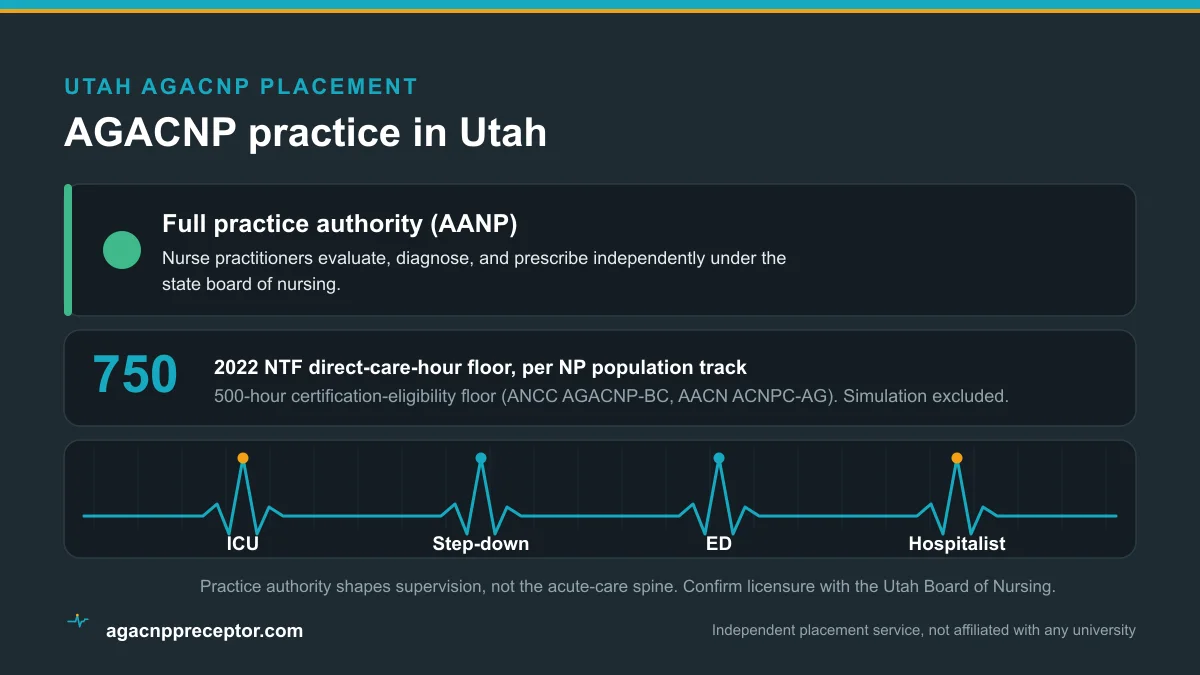
Utah grants nurse practitioners full practice authority, so an experienced acute-care nurse practitioner can precept with real independence. Prescribing still runs through the state's controlled-substance database and patient-consultation rules, and the Utah Division of Occupational and Professional Licensing publishes the current terms, so confirm them there.
Full authority shapes the arrangement more than the standard. In critical care an intensivist or a physician-led team is usually present as well, which is normal in high-acuity units everywhere. Your preceptor must hold a Utah license and practice in the acute setting that matches your rotation, whether that is a certified AGACNP or a physician in a matching inpatient role.
The patients behind adult-gerontology acute care here
AGACNP training happens inside the hospital, not the clinic, and the caseload runs from young adults through the frail elderly. In Utah's referral centers that means a heavy mix of complex cardiac, pulmonary, neurologic, and post-surgical patients, plus the trauma volume that flows in from a five-state region. Sepsis, respiratory failure, stroke, and the surgical intensive care unit fill much of a student's inpatient time, and the volume is deep enough to build real procedural exposure.
The thinner end is the adolescent range, which begins near age 13 and is harder to reach outside a large center. Mapping which population hours you still owe, from young adults to older adults, is part of building a rotation plan that actually closes out your requirements.
Rural Utah and the flight line to Salt Lake City
Beyond the corridor, Utah is large and sparsely settled. Southern and eastern Utah run on critical access hospitals that stabilize and transfer, and much of that transfer moves by air into Salt Lake City, since the University of Utah operates a well-known aeromedical service across the Mountain West. St. George in the southwest and the Ogden and Provo valleys carry more capacity, but the rarest cases still funnel to the capital.
For an AGACNP student outside the Wasatch Front, that usually means traveling or relocating for a block to reach high-acuity volume. Building that into your plan early keeps a rotation on track.
The hours that are hardest to secure here
The scarce blocks in Utah match the national pattern. High-acuity intensive care, procedures and advanced skills such as central lines, airway management, and ventilator care, and the adolescent end of the age range are the hardest to arrange alone.
Most of that capacity sits inside the Salt Lake City referral centers, where residents and other students compete for the same preceptors. Securing those blocks early protects your clinical hours.
How we place AGACNP students in Utah
We source and vet acute-care preceptors, then handle the credentialing and affiliation paperwork most students find hardest. Tell us your city, your program, and the rotations you still need, and we build a plan around the Wasatch Front hubs and any regional hospital within reach. See how it works and begin with the match form on this page. Matched first, and you can review the pricing before you commit.
Good to know
Do I have to train in Salt Lake City?
Not entirely, but the highest-acuity blocks usually happen there. The Salt Lake City referral centers hold the deepest intensive care and specialty volume, while Ogden, Provo, and St. George can cover many hours closer to home.
What does full practice authority change for my preceptor?
It lets a certified acute-care nurse practitioner precept with more independence. In critical care a physician-led team is usually present anyway, so the setting still feels collaborative. Your program sets the final preceptor rules.
How many clinical hours does AGACNP require?
The 2022 NTF Standards recommend at least 750 direct patient care hours, while ANCC and AACN certification eligibility require at least 500 supervised hours. Programs commonly publish totals from roughly 500 to 750 or more, so confirm your own number.
I live in rural Utah. Can you still place me?
Yes. Rural students often reach high-acuity hours by traveling to the Wasatch Front for a block, since southern and eastern Utah hospitals mostly stabilize and transfer. We plan that travel with you.
Do you only work with certain Utah programs?
No. We are independent and place students from any university. Your Utah location and the acute rotations you still need drive the plan, not your school.
Related
Secure the rotation no one else will hand you
Tell us your school, your city, and the acute rotations you still need. We will come back with a plan for the full AGACNP trace and a realistic path to placed.